
Redirect It! - Logic Puzzle
SayGames LtdPuzzle
4.84.05K Reviews
- Version
- 1.13.0
- Installs
- 5.00M
- Age Rating
- Everyone
Screenshots
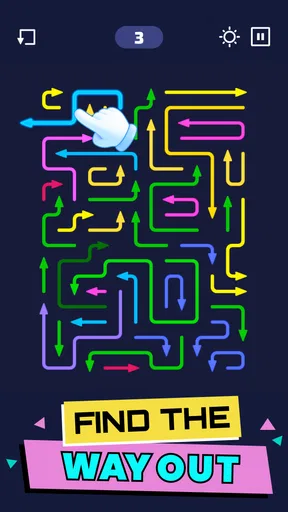
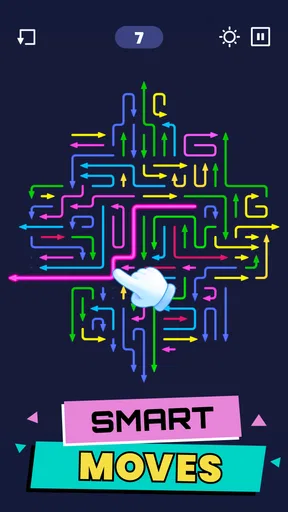
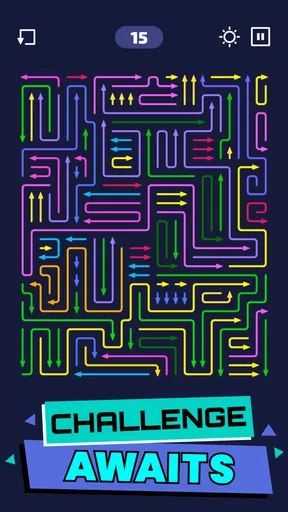
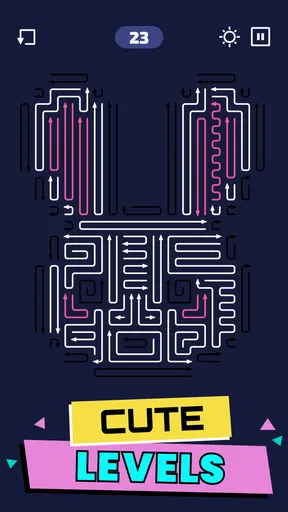
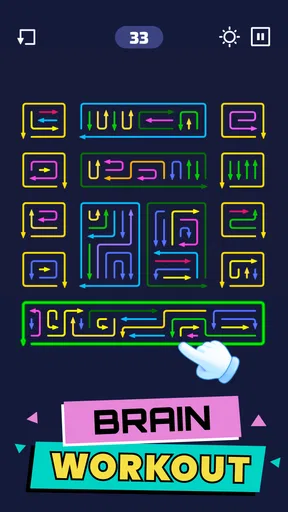
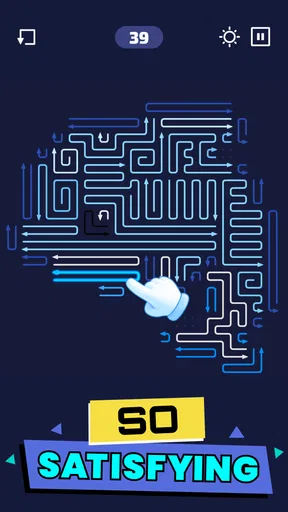
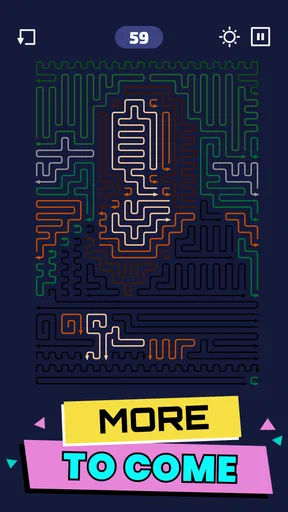
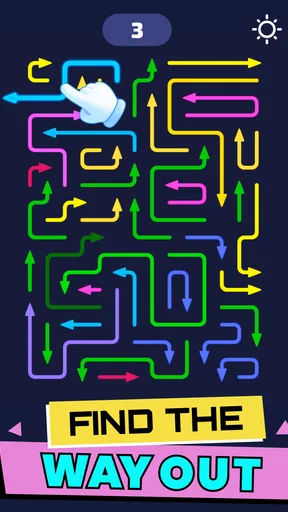
Our Review of Redirect It! - Logic Puzzle
 Analysis by Appyee
I picked up Redirect It! expecting a quick maze exercise, and that is exactly where its appeal lies: it asks for attention immediately, gives me a small problem to solve, and does not require a long warm-up before the game becomes enjoyable. The basic task is to remove every arrow from a maze by redirecting the paths correctly. It sounds simple, but the pleasure comes from seeing a messy-looking arrangement become orderly one decision at a time.
This is a minimalist puzzle game from SayGames Ltd, designed for the kind of player who wants something understandable within seconds. I do not need to learn a character’s abilities, remember a story, or manage a large collection of tools. I look at the board, work out how the arrows interact, and try to clear it. That narrow focus makes it especially suitable for short breaks, although it also creates limitations that become more noticeable if I play for a long stretch.
As a free puzzle game rated for Everyone, it is easy to recommend as a low-commitment download. It has reached over five million installs and holds a 4.8 average from around thirty-four thousand ratings, which fits my impression that its central idea is immediately accessible. The important question is not whether it is complicated; it is whether this particular kind of simplicity gives you enough satisfaction to keep returning.
Why the first few puzzles are so easy to pick up
The strongest part of the design is the opening interaction. The board communicates the problem visually, so I can begin experimenting instead of reading instructions for several minutes. Every arrow feels like part of a small traffic problem: change the direction, observe the result, and continue until the maze is clean. That makes the game approachable for people who usually avoid puzzle titles with dense menus or complicated rules.
I also like that the objective stays focused. Many mobile puzzle games surround a basic mechanic with collectibles, characters, missions, and layered progression. Here, the attention remains on the arrangement in front of me. The minimalist presentation helps because there is less visual noise competing with the puzzle itself. When I make a mistake, I am thinking about the mistake rather than wondering which menu or upgrade I should have used.
The best way to play is to avoid moving everything at random. I first look for arrows that appear to control the most crowded part of the maze, then trace where their redirection might open or block the remaining routes. This simple habit turns the game from trial-and-error tapping into a compact logic exercise. It is a useful distinction: the game is easy to start, but careful observation gives the puzzles more depth than the short summary suggests.
There is also an immediate visual reward in clearing a section. I get a sense of progress from reducing the clutter, even before the entire puzzle is finished. That small feedback loop works well during a one-minute pause because I do not need to build emotional momentum through a long level. The satisfaction arrives from making the board visibly simpler.
A rhythm that fits interruptions
In my experience, the game works best in short sessions rather than as a single extended challenge. I can begin while waiting for a drink, sitting on public transport, or taking a quick break between tasks. The premise is clear enough that I can start with almost no mental preparation, and the individual decisions are compact enough to fit around an unpredictable schedule.
The interruption-friendly quality matters more than it may seem. A game can be casual in theme but still demand uninterrupted concentration. Redirect It! feels more forgiving because I can inspect the current arrangement, make a small plan, and stop when I need to. If a message or conversation pulls me away, I am not abandoning a complicated strategy built over half an hour.
For a realistic everyday example, I would use it during a short lunch break when I want something more engaging than scrolling but do not have time for a full game. I can solve one puzzle, pause naturally, and return later without needing to remember a story or reconstruct a large tactical situation. That makes it a better fit for fragmented free time than a traditional match-based game that expects me to finish a round before leaving.
There is a trade-off, though. Short-session clarity does not automatically mean endless variety. Once I understand the main way of examining the maze, the experience depends heavily on how much the later arrangements continue to surprise me. The game gives me a clean mental activity, but it is not trying to be a deep strategy system with many distinct modes.
Returning after a pause
One of the useful qualities here is that the current challenge is visually self-contained. When I come back after putting my phone down, I can usually reorient myself by scanning the arrows and identifying the unfinished area. I do not need to remember a complicated sequence of actions or a set of temporary powers. The board itself tells me what remains to be solved.
That makes the game forgiving for players who are frequently interrupted. I would not choose it for someone who wants a dramatic, continuous campaign, but I would choose it for someone who wants a puzzle that can sit quietly in the background of a busy day. The mental reset is small: inspect the maze again, find the constraint, and continue.
A practical tip is to pause after making a change that affects several routes, rather than immediately tapping through the next few possibilities. When I return, I can identify the latest meaningful change and judge whether it improved the board. This prevents the common casual-game habit of making several impulsive moves and then forgetting which one caused the problem.
Another helpful approach is to treat the maze as a sequence of local decisions. I focus on one congested corner or one group of interacting arrows at a time instead of trying to understand the whole layout in one glance. That is especially useful on a small phone screen, where looking at every element simultaneously can become tiring. The game rewards a calm scan more than frantic speed.
Players may reasonably wonder whether they need to be a dedicated puzzle fan to enjoy it. I do not think so. The controls and goal are approachable enough for a casual player, while the need to predict consequences gives experienced puzzle players something to think about. The dividing line is not skill level but tolerance for repetition: if you need a new mechanic every few minutes, the focused structure may feel too narrow.
Where the repetition helps and where it starts to show
Repetition is not automatically a weakness in this game. Repeating the same core action lets me improve how I read a board. At first, I tend to react to the most obvious arrow. With practice, I start looking for dependencies, dead ends, and moves that simplify several routes at once. That gradual improvement is the main source of replay value.
The game is also pleasant when I want a predictable kind of concentration. Some days I do not want a new story or a demanding competitive match; I want a small problem with clear boundaries. Redirecting the arrows can serve that purpose well. It is closer to a mental reset than an all-consuming hobby, and its limited scope is part of why it is easy to revisit.
However, the same focus can make longer sessions feel less rewarding. If I play continuously, I may begin to notice the repeated shape of the experience: inspect, redirect, simplify, clear. That loop is satisfying when I am in the mood for it, but it may not hold my attention for hours. I would rather use it between other activities than make it my only mobile game.
This is where it differs from more elaborate puzzle alternatives. A story-driven puzzle game may offer characters, narrative surprises, and a stronger sense of destination. A match-three title may provide chain reactions, boosters, and a more energetic reward cycle. A daily puzzle may create a fixed ritual around one carefully selected challenge. Redirect It! sits apart from those options by keeping the board and its logic at the center. Choose it when you want low-friction reasoning, not when you want a broad progression system.
It is worth considering the free-to-play structure before deciding how often to use it. The game is free to download, with in-app purchases ranging from $0.99 to $99.99 per item. I would approach those purchases carefully and decide in advance whether the basic experience already gives me enough value. For a casual player, the safest mindset is to enjoy the core puzzles without treating optional spending as part of the challenge.
The current release is version 1.13.0 and supports devices running Android 8.0 or later. That makes compatibility a straightforward thing to check before installing, particularly if you use an older phone or tablet. On a supported device, the game’s uncomplicated presentation should suit people who prefer a clean puzzle screen over a visually crowded interface.
Who will enjoy it most
I would recommend Redirect It! to someone who wants a puzzle that explains itself through play. It is a good match for commuters, students between classes, office workers taking a brief mental break, and anyone who likes arranging a problem until the answer becomes obvious. It can also work for families because the age rating is Everyone and the central idea is easy to demonstrate without a long explanation.
It is particularly appealing if you enjoy finding order in a constrained space. The fun is not based on fast reflexes or memorizing a large rulebook. Instead, I get satisfaction from spotting which arrow should be handled first and watching the maze become less tangled. Players who enjoy compact logic tasks will probably understand the appeal quickly.
I would be more cautious about recommending it to someone looking for rich long-term progression. If your favorite mobile games are built around collecting, character development, competitive rankings, or a story that keeps changing direction, this may feel too bare. The minimalist approach removes distractions, but it also removes many of the systems that give other games a stronger sense of personal investment.
I would also skip it when I want a high-energy distraction. The pleasure here is quiet and methodical. It does not replace an action game when I need excitement, and it does not offer the social pressure of a multiplayer challenge. Its value comes from being easy to enter and easy to leave, not from creating a dramatic event every time I open it.
Small habits that make the puzzles more satisfying
My first useful habit is to identify the arrows that affect multiple possible routes. These are usually more important than an isolated arrow that can be solved later. I do not need to rush toward the most visible move; I try to find the move that reduces uncertainty for the rest of the maze.
My second habit is to preserve a mental checkpoint. After the board becomes noticeably simpler, I remember what the remaining cluster looked like before the next experiment. If the following move makes the arrangement worse, I can retrace the idea instead of continuing blindly. This is a better way to learn the puzzle’s logic than tapping through every option.
My third tip is to stop when I feel myself switching from reasoning to irritation. Because the game is built for short sessions, there is little benefit in forcing a solution while distracted. I can leave the puzzle, return with a clearer view, and often notice a relationship that was invisible before. The interruption-friendly structure turns taking a break into a practical solving technique rather than a failure.
Finally, I would keep the screen comfortable and avoid judging the game by speed. The point is not to perform a frantic sequence of taps. The strongest moments come when I understand why a redirection works. That slower approach also makes the game more suitable for a quiet break and less likely to become another source of pressure.
My casual verdict
Redirect It! succeeds because it respects the value of a small amount of free time. I can open it, understand the problem, make progress, and put it away without feeling that I have interrupted a larger commitment. The arrow-and-maze idea is simple, but the need to anticipate how one change affects the rest gives the activity enough substance to feel like real puzzle solving.
Its biggest strength is also its clearest boundary. The narrow design makes every session approachable, but players who need constant novelty may eventually want something broader. I see it as a companion game rather than a complete mobile entertainment library: something to keep available for waiting rooms, short commutes, and moments when I want to think without getting deeply involved.
With a 4.8 average from roughly thirty-four thousand ratings, the reception reflects how accessible the concept is, while the five-million-plus install count shows that it has found a substantial casual audience. I would not use those figures as a reason to install it by themselves, but they match the game’s easy entry point.
My recommendation is simple: try it if you want a free, minimalist logic game that tolerates interruptions and gives quick, tidy satisfaction. Keep your expectations realistic about repetition and optional purchases, and it becomes a pleasant little puzzle for the gaps in the day. If you want a story, deep progression, or constant mechanical change, choose a more expansive alternative instead. For quiet, short-session brain training, though, SayGames Ltd has made a focused game that is easy to return to.
Verdict
Strengths of Redirect It! - Logic Puzzle
- Simple rules make it easy to start playing immediately.
- Short levels are ideal for quick breaks or casual sessions.
- Increasing difficulty keeps the puzzles engaging over time.
- Minimalist visuals keep attention focused on solving each level.
- Works well for players who enjoy logic and spatial challenges.
Limitations of Redirect It! - Logic Puzzle
- Some puzzles may feel repetitive after extended play sessions.
- Later levels can become frustrating without a clear undo strategy.
- Hints or extra assistance may be limited in difficult stages.
- The game may offer little appeal to players seeking story content.
- Progress can feel slow if levels require several trial-and-error attempts.
Other Releases by SayGames Ltd
View All
Turbo Stars - Rival Racing
Racing4.6

Johnny Trigger: Action Shooter
Action4.6

DOP 4: Draw One Part
Puzzle4.4

DOP: Draw One Part
Puzzle4.4
Similar Picks in This Category
View All
Block Blast!
HungryStudio4.8

Braindom: Brain Games Test
Lahana Game Studio4.6

AMAZE!
CrazyLabs LTD4.6

Sudoku - Classic Sudoku Puzzle
Oakever Games4.7

Art Puzzle - Puzzle Games
Easybrain4.8

Amaze GO!
Oakever Games4.9
Frequently Asked Questions
What is Redirect It! - Logic Puzzle, and how is the gameplay structured?
Redirect It! - Logic Puzzle is a brain-training game based on guiding moving objects toward their correct destinations. Each level presents a compact puzzle board with paths, obstacles, switches, or directional elements that must be arranged or activated in the right order. The early stages are easy to understand, while later puzzles require planning several moves ahead and carefully considering how one action affects the entire route.
Is Redirect It! - Logic Puzzle suitable for beginners or casual players?
Yes. The game is approachable for beginners because its mechanics are introduced gradually rather than explained all at once. The initial levels work as practical tutorials, allowing you to learn by experimenting with the board. However, it is not limited to very young or casual players; as the difficulty increases, solving a level may require patience, spatial reasoning, and repeated attempts instead of simple trial and error.
Does Redirect It! - Logic Puzzle require an internet connection to play?
The main puzzle experience is generally designed for short, self-contained sessions, making it convenient for playing while traveling or when you have limited connectivity. Some features, such as advertisements, analytics, updates, cloud-related functions, or store services, may still depend on an internet connection. It is best to launch the game once online after installation and check which features remain available offline on your device.
Are there hints, solutions, or ways to recover when a puzzle becomes too difficult?
When a level becomes challenging, the best approach is usually to reset the board and study the complete route before making another move. Depending on the version installed, the game may provide hints, level resets, or other assistance, although these options can sometimes be limited or connected to advertising or in-game systems. Players who enjoy pure logic can often ignore help and solve every puzzle independently.
Is Redirect It! - Logic Puzzle free to download, and does it contain ads or in-app purchases?
The game can typically be downloaded without an upfront purchase, but the exact monetization model may vary between Android and iOS and can change with future updates. Free versions may include advertisements, optional purchases, or paid features such as removing ads or obtaining extra assistance. Before downloading, review the current store listing, permissions, age rating, and purchase information to understand the conditions offered in your region.
Play our best games!


